Quality Assurance

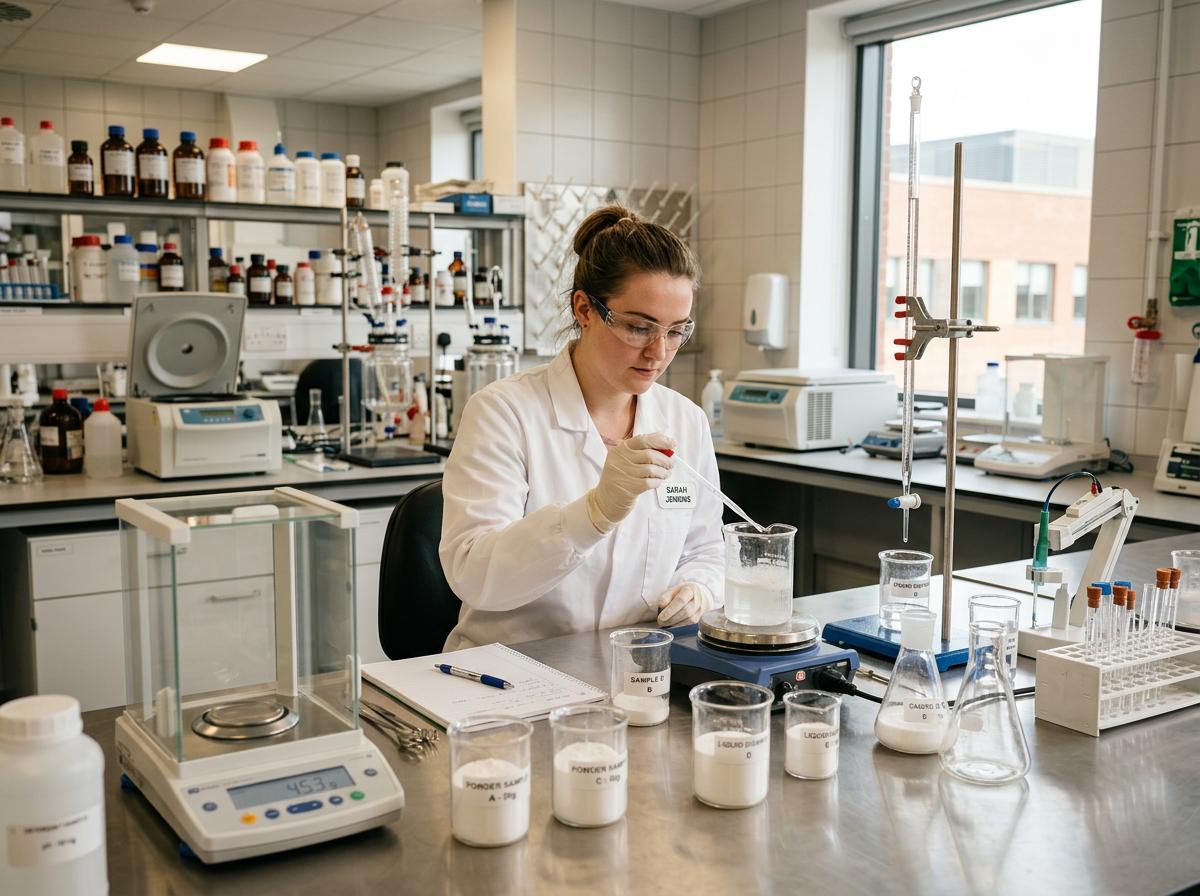
Quality Control Laboratory

Standard operating procedures, testing protocols, and quality assurance systems for detergent manufacturing

Standard Operating Procedures

Established protocols ensuring consistent quality and regulatory compliance across all testing activities

Required Laboratory Equipment

  • Analytical balance (0.0001 g precision)
  • pH meter with calibration buffers
  • Viscometer (Brookfield or equivalent)
  • Oven with temperature control (±1°C)
  • Desiccator with silica gel
  • Spectrophotometer for color measurement
  • Conductivity meter
  • Karl Fischer titrator for moisture
  • Centrifuge (4000 rpm minimum)

Calibration Procedures

  • Calibrate balance daily with certified weights
  • Calibrate pH meter with pH 4.0, 7.0, 10.0 buffers
  • Verify viscometer with standard oil quarterly
  • Check oven temperature with thermocouple monthly
  • Validate spectrophotometer with standard filters
  • Replace KF reagent when drift exceeds threshold
  • Document all calibration activities in logbook
  • Label equipment with next calibration due date

Analysis Steps

  • Sample preparation per material specification
  • Active matter determination by extraction
  • pH measurement at 1% solution concentration
  • Viscosity measurement at 25°C ± 0.5°C
  • Bulk density by standardized funnel method
  • Moisture content by gravimetric or KF method
  • Color measurement against reference standard
  • Document all results on analysis worksheet

Sampling Templates

  • Unique sample ID with date and batch reference
  • Supplier name and certificate of analysis
  • Quantity received and storage location
  • Visual inspection: color, odor, appearance
  • Date sampled and sampler identification
  • Tests required per material specification
  • Quarantine status: HOLD / APPROVED / REJECTED
  • Chain of custody documentation

Batch Acceptance Forms

  • Batch number and production date
  • Raw material lot numbers used
  • In-process test results (pH, viscosity, density)
  • Finished product specification checklist
  • QC inspector signature and date
  • Production manager approval
  • Hold period results (24h, 48h stability)
  • Final release or rejection decision

Cost Calculation by Active Matter

  • Determine active matter % of each raw material
  • Calculate cost per kg of active matter
  • Formula: Cost per kg active = (Price × 100) / Active %
  • Compare suppliers on active-matter basis
  • Account for handling and storage costs
  • Include quality premium for consistent supply
  • Update calculations with current market prices
  • Use for make-vs-buy and substitution decisions

Deviation Evaluation

  • Document deviation with batch number and date
  • Describe deviation nature and suspected cause
  • Assess impact on product quality and safety
  • Review historical data for similar deviations
  • Determine if batch can be reworked or blended
  • Escalate critical deviations to quality manager
  • Implement corrective and preventive actions (CAPA)
  • Close deviation after verification of effectiveness

Final Product Approval Criteria

  • All in-process parameters within specification
  • Finished product meets full QC specification
  • Stability test passed (48h at 45°C, freeze-thaw)
  • Microbiological test results acceptable
  • Packaging and labeling verified correct
  • Shelf-life dating confirmed
  • QC and production manager dual sign-off
  • Release only after all criteria met
Laboratory Methods Library

40 validated analytical methods, fully documented

Every method below ships with its reagent list, data tables, calculation outputs and a one-click branded PDF — engineered for bench use, not just reading.

40
Methods
6
Categories
33
Data tables

Showing 40 of 40 methods

Surfactants
P17.1

Active Matter Determination for Anionic Surfactants — Potentiometric Titration

Quantitative two-phase titration using an ion-selective electrode to detect the equivalence point between an analyte surfactant and a counter-ion standard.

3Reagents
1Data sets
7Data rows

Key reagent: Hyamine 1622 (benzethonium chloride) — 0.004 M (≈1.792 g/L)

Surfactants
P17.2

Active Matter Determination for Nonionic Surfactants — Cobalt Thiocyanate Complexation Method

Colorimetric complexation between nonionic surfactant ethoxylate groups and cobaltothiocyanate, extracted into dichloromethane and read at 620 nm.

4Reagents
0Data sets
0Data rows

Key reagent: Ammonium cobaltothiocyanate reagent — Dissolve 30.0 ± 0.1 g Co(NO₃)₂·6H₂O and 200.0 ± 0.1 g NH₄SCN in water

Equipment
P17.3

pH Measurement — Electrode Calibration and Temperature Correction

Glass-electrode potentiometry with multi-point buffer calibration and automatic temperature compensation.

0Reagents
1Data sets
10Data rows
Wet Chem
P17.4

Moisture Content Determination — Karl Fischer Titration and Oven Drying

Coulometric or volumetric determination of water content based on the stoichiometric reaction of water with iodine in a methanolic Karl Fischer reagent.

0Reagents
1Data sets
6Data rows
Physico
P17.5

Density and Specific Gravity — Hydrometer, Digital Densitometer, and Pycnometer Methods

Gravimetric or oscillating U-tube measurement of mass per unit volume at a controlled reference temperature (typically 20 °C).

0Reagents
1Data sets
8Data rows
Performance
P17.6

Solubility Test — Dissolution Rate and Visual Clarity Assessment

Nephelometric turbidity (NTU) measurement combined with visual clarity scoring under standardized light conditions.

0Reagents
1Data sets
8Data rows
Performance
P17.7

Foam Test — Ross-Miles Foam Height

Standardized foam-generation method (ASTM D1173): a calibrated sample volume falls from a pipette into a receiver; foam height is recorded at t=0 and t=5 min.

0Reagents
1Data sets
7Data rows
Physico
P17.8

Viscosity Measurement — Brookfield Viscometer

Rotational viscometry — torque required to rotate a calibrated spindle in the sample is converted to apparent dynamic viscosity (cP).

0Reagents
1Data sets
7Data rows
Performance
P17.9

Thermal Stability Test — Accelerated Storage at 40°C / 75% RH

Accelerated aging at elevated temperature and humidity to project ambient-storage shelf life of the formulation.

0Reagents
1Data sets
6Data rows
Performance
P17.10

Compatibility Test — Binary Mixtures with Key Co-ingredients

Binary stress test of the formulation against key raw materials, scored on phase behaviour, color and odor after thermal cycling.

0Reagents
1Data sets
9Data rows
Physico
P18.1

Apparent Bulk Density Measurement — ISO 697:1981 Method

Mass-to-volume ratio of loosely poured powder under controlled drop conditions, reported in g/L per ISO 697:1981.

0Reagents
1Data sets
7Data rows
Physico
P18.2

Moisture Content — Oven Drying and Karl Fischer Methods

Coulometric or volumetric determination of water content based on the stoichiometric reaction of water with iodine in a methanolic Karl Fischer reagent.

0Reagents
0Data sets
0Data rows
Surfactants
P18.3

Total Active Matter — Extraction and Titration

Standardized analytical method with controlled sampling, calibrated instrumentation, and documented acceptance criteria.

0Reagents
0Data sets
0Data rows
Physico
P18.4

Particle Size Distribution — Sieve Analysis

Mechanical fractionation of the powder through a calibrated sieve stack with mass-balance reporting per fraction (ISO 8130).

0Reagents
1Data sets
5Data rows
Performance
P18.5

Dissolution Rate and Dispersibility

Standardized analytical method with controlled sampling, calibrated instrumentation, and documented acceptance criteria.

0Reagents
0Data sets
0Data rows
Physico
P18.6

Flowability — Angle of Repose and Carr Index

Carr compressibility index and angle of repose to classify the powder's flow behaviour (free-flowing → cohesive).

0Reagents
1Data sets
7Data rows
Physico
P18.7

pH Measurement — Calibrated Glass Electrode

Glass-electrode potentiometry with multi-point buffer calibration and automatic temperature compensation.

0Reagents
0Data sets
0Data rows
Physico
P18.8

Viscosity — Brookfield Viscometer

Rotational viscometry — torque required to rotate a calibrated spindle in the sample is converted to apparent dynamic viscosity (cP).

0Reagents
1Data sets
7Data rows
Surfactants
P18.9

Active Matter Content — Anionic and Nonionic

Standardized analytical method with controlled sampling, calibrated instrumentation, and documented acceptance criteria.

0Reagents
2Data sets
14Data rows
Physico
P18.10

Clarity and Turbidity Assessment

Nephelometric turbidity (NTU) measurement combined with visual clarity scoring under standardized light conditions.

0Reagents
0Data sets
0Data rows
Performance
P18.11

Thermal Stability — Accelerated Storage Test

Accelerated aging at elevated temperature and humidity to project ambient-storage shelf life of the formulation.

0Reagents
1Data sets
7Data rows
Performance
P18.12

Cold Stability — Low-Temperature Storage Test

Accelerated aging at elevated temperature and humidity to project ambient-storage shelf life of the formulation.

0Reagents
0Data sets
0Data rows
Surfactants
P19.1

Cationic Active Matter Determination — Potentiometric Titration

Quantitative two-phase titration using an ion-selective electrode to detect the equivalence point between an analyte surfactant and a counter-ion standard.

0Reagents
0Data sets
0Data rows
Performance
P19.2

Emulsion Stability — Centrifuge Test

Centrifuge-accelerated phase-separation test to predict shelf-life resistance to creaming or coalescence.

0Reagents
1Data sets
5Data rows
Wet Chem
P19.3

Total Acid Content — Acid-Base Titration

Standardized analytical method with controlled sampling, calibrated instrumentation, and documented acceptance criteria.

0Reagents
1Data sets
5Data rows
Wet Chem
P19.5

Corrosion Testing — Weight Loss Method

Gravimetric weight-loss of standardized metal coupons exposed to the formulation under controlled time/temperature conditions.

0Reagents
2Data sets
14Data rows
Performance
P19.6

Evaporation Rate — Standardized Film Method

Gravimetric tracking of mass loss of a calibrated thin film under controlled airflow and temperature.

0Reagents
1Data sets
4Data rows
Performance
P19.7

Streak-Free Performance — Standardized Soiled Panel Test

Visual / instrumental scoring of dried-film residue on standardized soiled panels after controlled wipe-down.

0Reagents
2Data sets
10Data rows
Surfactants
P2.1

Methylene Blue Active Substances (MBAS) Test for Anionic Surfactant Identification

Two-phase extraction of methylene blue–anionic surfactant ion pair into chloroform with photometric detection at 652 nm.

0Reagents
0Data sets
0Data rows
Surfactants
P2.2

Cobalt Thiocyanate Active Substances (CTAS) Test for Nonionic Surfactant Identification

Colorimetric complexation between nonionic surfactant ethoxylate groups and cobaltothiocyanate, extracted into dichloromethane and read at 620 nm.

0Reagents
0Data sets
0Data rows
Equipment
P20.2

Equipment Calibration Schedule

Risk-based interval matrix mapping each instrument family to its calibration cadence, tolerance window and responsible role.

0Reagents
1Data sets
8Data rows
Process
P21.1

General Liquid Detergent Batch Process

Sequenced unit operations: charging, hydration, neutralization, viscosity build, and finish — with in-process QC checkpoints.

0Reagents
1Data sets
10Data rows
Process
P21.2

High-Viscosity Product Manufacturing

Sequenced unit operations: charging, hydration, neutralization, viscosity build, and finish — with in-process QC checkpoints.

0Reagents
1Data sets
10Data rows
Process
P21.3

Dry Mixing/Blending Process

Sequenced unit operations: charging, hydration, neutralization, viscosity build, and finish — with in-process QC checkpoints.

0Reagents
1Data sets
8Data rows
Process
P21.4

Spray Drying Slurry Preparation

Sequenced unit operations: charging, hydration, neutralization, viscosity build, and finish — with in-process QC checkpoints.

0Reagents
1Data sets
13Data rows
Equipment
P23.1

Daily Mixer Inspection

Preventive maintenance and inspection protocol with sign-off checklist, frequency, and acceptance criteria.

0Reagents
1Data sets
7Data rows
Equipment
P23.3

Pump Maintenance Schedule

Preventive maintenance and inspection protocol with sign-off checklist, frequency, and acceptance criteria.

0Reagents
1Data sets
5Data rows
Equipment
P23.4

Storage Tank Cleaning and Inspection

Accelerated aging at elevated temperature and humidity to project ambient-storage shelf life of the formulation.

0Reagents
0Data sets
0Data rows
Equipment
P23.5

Filling Line Maintenance

Preventive maintenance and inspection protocol with sign-off checklist, frequency, and acceptance criteria.

0Reagents
0Data sets
0Data rows
Equipment
P23.6

Emergency Shutdown Protocol

Preventive maintenance and inspection protocol with sign-off checklist, frequency, and acceptance criteria.

0Reagents
1Data sets
8Data rows

Troubleshooting Guide

Common manufacturing problems, their root causes, and proven solutions developed through production experience

Why did viscosity drop?

Possible Causes

  • Insufficient electrolyte (salt) content in the formula
  • Active surfactant content below specification
  • Incorrect order of addition during mixing
  • Temperature too high during processing (>50°C)
  • Use of wrong surfactant grade or dilution
  • Excess water addition beyond formula target
  • Shear degradation from excessive mixing speed

Recommended Solutions

  • Add electrolyte (NaCl) gradually — 0.1% increments until target viscosity reached
  • Verify active matter content and top up if below target
  • Follow correct addition sequence: water → surfactant → additives → electrolyte last
  • Cool batch to 25–30°C before adding electrolyte or thickening agents
  • Verify raw material certificates of analysis for correct grade
  • Check water content and adjust formula calculations
  • Reduce mixing speed and duration for shear-sensitive thickeners

Prevention

  • Always add electrolyte last and in small increments with mixing between additions
  • Verify active matter by titration before batching
  • Control process temperature within 25–35°C range
  • Use calibrated flow meters for water addition
  • Document optimal mixing parameters for each SKU

Why did separation occur in the liquid?

Possible Causes

  • Incompatibility between surfactant types (anionic + cationic)
  • Insufficient mixing time or intensity for emulsion formation
  • Temperature shock during processing or cooling
  • Excess oil-soluble components without adequate solubilizer
  • Incorrect HLB balance in the surfactant system
  • Insufficient co-surfactant or hydrotrope level
  • Hard water ions causing precipitation of anionic surfactants

Recommended Solutions

  • Re-mix batch with high-shear mixer for 15–20 minutes at controlled temperature
  • Add co-surfactant or solubilizer (e.g., coco-glucoside, PEG-40 hydrogenated castor oil)
  • Heat gently to 40°C while mixing to re-disperse separated phases
  • Add hydrotrope (xylene sulfonate or urea) at 1–3% to improve compatibility
  • Check for cationic contamination and replace incompatible raw materials
  • Use chelating agent (EDTA or citrate) to complex hard water ions
  • If irreversible, consider blending off into a lower-grade product

Prevention

  • Always perform compatibility testing before introducing new raw materials
  • Follow validated mixing protocols with specified time and speed
  • Control cooling rate — no faster than 5°C per hour
  • Add solubilizer for fragrance and oil-soluble additives
  • Use deionized water for all liquid detergent production

Why did moisture increase in the powder?

Possible Causes

  • Inlet air temperature too low in spray dryer
  • Feed rate too high — insufficient residence time in drying zone
  • Atomizer pressure or speed below specification
  • High ambient humidity during packaging or storage
  • Leaking steam coils or humid air ingress in dryer
  • Incorrect air balance — exhaust flow insufficient
  • Powder particle size too fine — increased surface area for moisture absorption

Recommended Solutions

  • Increase inlet air temperature by 10–20°C and monitor outlet temperature
  • Reduce feed rate to achieve specified residence time (verify with density check)
  • Check atomizer disc speed or nozzle pressure — clean or replace clogged nozzles
  • Install dehumidifier in packaging area; pack immediately after cooling
  • Inspect dryer seals and steam system for leaks; repair as needed
  • Adjust exhaust fan speed to achieve negative pressure in drying chamber
  • Optimize atomization to produce larger, more uniform particle size

Prevention

  • Monitor inlet and outlet air temperatures continuously with alarms
  • Calibrate feed pumps weekly and verify flow rates
  • Clean atomizer daily and inspect nozzles for wear
  • Maintain packaging area relative humidity below 50%
  • Seal all dryer inspection ports and maintain negative pressure

Why is the density unsuitable?

Possible Causes

  • Slurry solids content too high or too low before spray drying
  • Incorrect ratio of light (soda ash) to dense (STPP) builders
  • Atomizer settings producing wrong particle size distribution
  • Air infiltration into dryer causing over-drying and hollow particles
  • Excessive post-tower fines content affecting bulk density
  • Incorrect raw material grades (e.g., light vs dense soda ash)
  • Tower operating temperature affecting particle porosity

Recommended Solutions

  • Adjust slurry solids to target 55–65% before pumping to tower
  • Reformulate builder ratio — increase dense builders to raise density, increase light fillers to lower
  • Adjust atomizer speed/pressure to achieve target particle size (D50: 300–500 μm)
  • Check dryer seals and air balance; control air ingress points
  • Install fines return system or adjust cyclone separator settings
  • Verify raw material bulk densities against specifications before use
  • Reduce inlet temperature slightly to produce denser, less porous particles

Prevention

  • Measure slurry solids content before every batch and at tower inlet
  • Verify raw material bulk density on receipt and quarantine off-spec materials
  • Monitor particle size distribution hourly using sieve analysis
  • Maintain atomizer according to manufacturer schedule
  • Document density vs. temperature correlation for your tower

Why is dissolution slow?

Possible Causes

  • Excessive coarse particles in powder (>1 mm fraction)
  • High levels of poorly soluble fillers (talc, calcium carbonate)
  • Over-dried powder with hard, glazed particle surfaces
  • Incorrect binder level causing excessive particle hardness
  • High STPP or zeolite content without sufficient hydration time
  • Cold water temperature reducing surfactant solubility
  • Powder compaction or caking during storage

Recommended Solutions

  • Adjust milling or screening to reduce coarse fraction; target <5% above 1 mm
  • Replace inert fillers with more soluble alternatives (sodium sulfate, soda ash)
  • Reduce dryer outlet temperature to produce more porous, soluble particles
  • Reduce binder (CMC or PEG) level or switch to faster-dissolving grade
  • Ensure zeolite is fully hydrated before use; pre-dissolve STPP in hot water
  • Add dissolution aid (urea or toluene sulfonate) at 1–3% in formula
  • Improve packaging to prevent moisture uptake and caking during storage

Prevention

  • Screen powder before packaging to remove coarse fraction
  • Dissolution test every batch: 1 g in 1 L water at 20°C, stir 60 seconds
  • Control moisture content to 8–12% for optimal dissolution vs. stability balance
  • Use anti-caking agent (silica or talc) at 0.5–1% if storage conditions are humid
  • Specify cold-water soluble grades for all surfactants and polymers

Why did product quality decline after storage?

Possible Causes

  • Moisture uptake during storage causing hydrolysis of sensitive components
  • Fragrance loss due to volatility or reaction with alkaline components
  • Enzyme degradation from heat and moisture exposure
  • Oxidation of surfactants or additives causing discoloration and odor
  • UV light exposure degrading optical brighteners and dyes
  • Microbial contamination in inadequately preserved products
  • Incompatible packaging materials allowing gas permeation

Recommended Solutions

  • Improve packaging barrier properties — use laminated films or sealed containers
  • Switch to encapsulated or protected fragrances with better retention
  • Ensure enzyme coating integrity; add stabilizers (borates, propylene glycol)
  • Add antioxidant (BHT or tocopherol) at 0.05–0.1% to prevent oxidation
  • Use opaque or UV-protective packaging; avoid clear containers for retail
  • Verify preservative system efficacy with challenge testing
  • Review packaging specifications — oxygen transmission rate and water vapor transmission rate

Prevention

  • Accelerated stability test: 4 weeks at 45°C before product launch
  • Specify packaging WVTR < 2 g/m²/day and OTR < 0.5 cc/m²/day
  • Include desiccant in bulk packaging for moisture-sensitive formulations
  • Store finished goods in cool, dry warehouse (< 30°C, < 60% RH)
  • Implement FIFO (First In, First Out) inventory management
SymptomLikely causeCorrective action
Powder bulk density too highInsufficient slurry de-aeration; nozzle wear; high slurry density.Increase de-aeration; replace nozzles; reduce filler / increase water.
Powder bulk density too lowOver-aeration; nozzle pressure too low; high inlet temperature.Reduce de-aeration / add re-aeration; raise pump pressure; lower inlet T.
High powder moistureLow inlet temperature; high slurry feed rate; low exhaust flow.Raise inlet T; reduce slurry rate; increase exhaust fan speed.
Sticky tower wallsHigh slurry moisture; wrong nozzle angle; under-temperature.Reduce water; correct nozzle position; raise inlet T.
Slurry pump cavitationAir entrainment in slurry preparator; clogged suction strainer.Lower agitator speed; clean strainer; check level in slurry tank.
Liquid detergent viscosity drop after 24 hSalt over-dosing; pH drift; SLES under-active.Reduce salt; re-buffer pH; verify SLES active matter.
Liquid detergent separationIncompatible perfume; insufficient hydrotrope; temperature shock.Add solubilizer (propylene glycol); pre-blend perfume; control mixing T.
Powder caking in storageHigh moisture; hygroscopic raw material exposed; poor packaging seal.Re-dry; switch filler; improve packaging barrier.
Low foam in dishwashHard water; under-dose CAPB; preservative incompatibility.Add chelant; increase CAPB; switch preservative.